Sunday, 6 March 2022

Hemantha Kalam - 100 "Men who mattered more - Uncle Sarma'

    (Most of the back dates are courtesy my mother’s rich memory! 

Dates about Sarma uncle are from his family members!)

(‘Garu’ (pronounced Gaaru) is a respectful addressing in the Telugu language – something like Sir)

It was on 21st July, 2013 that I wrote my first blog. Though I did not chalk out any time table for writing, I thought to myself that it would be nice if I could write a blog every fortnight. However, as is being seen now, that wouldn’t be the case! Either for lack of creative juices, or suffering from the writer’s block, which I do suffer a bit from, or sheer laziness, it took me almost nine years to hit a century which made it about an average of one blog a month. Nothing great really, but not bad either.

There have been faithfuls who have always responded to my earlier 99 blogs and encouraged me to keep at it. There also were some, who requested that I don't send my blogs anymore to them as they considered them as spam. And then there have been silent readers who, on occasion, said that they did not seem to be receiving my blogs anymore, which is so reassuring, indeed! So on the occasion of hitting a century of blogs, A “BIG THANK YOU” to each one of them and you, my dear reader.

But being the 100th blog, I thought I would write this for someone who really had a role in shaping up my life. That set the machine (I do think I have one alright, hunh..) working in my mind and I started thinking who could have influenced me and who could have been my role model.

As a member of the society, I know, for sure, that every person I came across in my life, for more than half an hour, had some influence on me – be it good, bad or ugly. I have certainly learnt from and influenced by every one that I came into contact in this global community. If I am not acknowledging that, yes, I am fooling myself. But, what about a role model for me? Alas I don’t seem to have a single person, in my mind, who I can call my role model, till date. I am a mostly self-made man shaped by the forces of the society.

Well, I had been a seeker all my time. If it is not knowledge, it is a job or money or fun or new places or what not! So, around the turn of the new millennium, I was seeking – a job, and a bit desperately too, as I was getting to be unemployed soon.

I had received an interview invitation from the MD of a lower-mid ranging advertising agency in Chennai, for a job, in their creative department, with a major focus on copy-writing. I was always fancying myself as an ad guy (I have been a member of the Ad Club too) and so was pleased to accept the invitation. I am also a polyglot and having airs of creativity – I have it or not, only my poor audience can vouchsafe!

The only question the MD asked me during the interview was “who is your role model?” I was zapped, as I didn’t think of any person as my role model. I still don't do! And in all truthfulness, I told him so – that I didn’t have a role model. Had the question been who inspired me, probably I would have had an answer for that, but the MD did not ask me that question.

The MD said that the interview concluded and he cannot offer a job to a person who doesn’t seem to be having a role model! He didn’t say it in so many words, but his looks conveyed to me that I was an alien to him and that he was being very wary of me. Till this day, for the heck of it, I don’t understand why I should have a role model for myself to qualify for the job of a copy-writer in an ad agency.

So, some 20 years later, I thought I shall try answering his question, still not the way he wanted though, but for whatever it is worth and for a reason. I am not getting any younger and if not now, when?

There have been several people who inspired me in my life. Apart from my parents and some of our relatives, any number of persons had inspired me. Every time I saw a picture on the cover pages of business magazines, I was inspired and sought that one day I should be written about too! I haven’t reached that spot yet, but I can certainly say that I had tried making my way in that direction and have been written about in magazines and even in foreign newspapers. I may or may not reach the wider spot, but I can die with the satisfaction that consciously I did my bit though! I was inspired by the comic hero ‘The Phantom’. I was inspired by Dara Singh, the wrestler.

But, apart from my parents and immediate family members, there have been a clutch of persons in my life who had clearly inspired me in measurable ways. This blog is the beginning of a blog series to acknowledge my association with those good persons.

So let me start at the beginning - with the first person, who helped me gain my knowledge, whatever etiquette and manners I could learn and in general, my demeanour,  Late Evani Krishna Sarma or Sarma mavayya garu (Uncle Sarma) (the surname Evani is to be pronounced as 'Eevani").

Madras (now Chennai) has been our foster city which nurtured us in its warm bosom (sometimes really hot too, but never mind that). I grew here, learnt here, imbibed its culture to a large extent and probably may also die here. But when I arrived in Madras on the 1st November, 1957 (exactly on the first anniversary of the formation of my native state Andhra Pradesh) along with my mother, my father, who was already in Madras, was living with some friends.

With the arrival of his wife and a son, it became imperative for him to shed his ‘bachelorhood’ and become a responsible family head. The first thing needed for that was a house of his (ok, ok, ours). So, on 28th November, 1957, we entered our house in Ramanujam Street in Thyagaraya Nagar (the spelling ‘Theagaraya’ came in much later with the interference of super intelligentsia in the bureaucracy) or T. Nagar of Madras. It was just a hut or a cottage if we have to add some respect to a home. As I was a toddler, and could remember only a few glimpses / scenes of the house, I guess the dimensions were some 8 (W) x 12 (L) x 10 (H) feet hut with a small porch of about 2 ½ feet in front. It was one long room which served as the living room, hall, bedroom and kitchen. Kitchen could be demarcated by a curtain. Bath and toilet were outside and common for all tenants. The rent was a princely Rs.15 per month with Rs.1 extra for the power.

The house owner Late Ranga Pillai constructed some huts in his compound and let them on rent for economically poor and ultra lower middle class people. But he always ensured strict discipline among the tenants and the cleanliness of the premises and the public utilities in the compound.

We stayed in the place till August, 1960 (a different blog on life in the hut in Ramanujam street later, perhaps). As Ranga Pillai kept pressurising us to vacate (normally landlords do not want the tenants to stay longer in the same premises) we found a house, a couple of kilometres away,  again in the same T. Nagar area, in a street called Chinnaiah Pillai Street. Late Chinnaiah Pillai was a famous advocate and as he constructed the first house in the street, it was named after him (as the system was in vogue in those days in Madras).

The premises were in an interesting neighbourhood. We had the husband and wife film playback singer duo of A. M. Rajah and Jikki (P. J. Krishnaveni) as a neighbour and living diagonally behind us was the famous film actress Shavukaru Janaki (more popularly known as ‘Sowcar’ Janaki). Living a few houses away was another film actress E. V. Saroja. I cannot swear on it but I understood that at some point of time, even the famous actress B. Saroja Devi was a resident of the street.

A few blocks away Chakravarti Rajagopalachari had his Swatantra party’s office and the other side again a few blocks away was chief minister Kamaraj’s house. I had seen the unassuming down to earth Kamaraj ji several times while going to or coming from school. He had just one or two policemen taking care of his security. With such illuminating neighbourhood and later with my father’s professional connections, it is only natural that my filmy and political knowledge gained considerably.

But, back to the original story! We arrived at our new home at No.3 Chinnaiah Pillai Street, on the 8th August, 1960 along with our frugal possessions that were carried on a bullock cart. We had occupied the backside house; what normally is referred to as ‘Out House’. Actually, this was originally constructed for the watchman and for storing the construction material, during the construction of the main building. Once the construction was over, it was to be dismantled. But then there was a big car shed adjoining the house and so it was left off. Our home was of one small hall cum living cum bed room, a kitchenette and outside, connected was a small bathroom. Here too the toilet was away from the outhouse and was in a corner portion of the main building with access from outside. Our home was covered by asbestos sheets.

There were two mango trees in front of our home giving us a generous supply of shade and leaves for auspicious occasions but never any mangoes. In all the years we stayed there, we never saw them yield any mangoes at all. These trees were fondly called as "Rama Lakshmanulu". During summer, we used to sleep on camp cots, under these trees. Behind the trees was a small hut where Mr. Ponnuswamy’s family lived. Ponnuswamy used to do some odd jobs and stayed for some time.

Now, this whole house belonged Sarma mavayya garu. His was a well-to-do family and never really wanted to or needed to rent the ‘Out House’. But since known persons recommend, sometimes he used to oblige by letting out the place. The previous tenants of the house used to pay Rs.25 per month as rent (interestingly, I married the niece of the earlier tenant's wife). But when he came to know of my father’s precarious work situation, he offered the house to us at Rs.20 per month all inclusive. Only condition is that we have to keep the house clean, and that the rent should positively be paid on the first of every month without the need for asking or follow-up in any way.

Once settled, we were upto ourselves. My father was either working or trying for work and it was just my mother and I, left to ourselves. So my mother took it upon herself to start teaching me. That way it is my mother who had been my first guru and she has been so till that position has been usurped by my children now. I learn all the new and hick things from them nowadays.

My mother hung a big hard-board sheet with large hand-written Telugu alphabets on it (which she prepared herself) and made me recognise them by sight and rote. So I learnt alphabets without ever writing them. This was so because I was not officially initiated into learning by the ritual called ‘Akshara abhyaasam” ('akshara' is alphabet and 'abhyaasam' is practice). I just completed four years and four years was too early to start any stratified learning, those days.

Yeah, chubby cheeks, dimple chin and that’s me!

Pic: Circa 1961-62 by late J. P. Sastry (maternal uncle)

The auspicious day of ‘Vijayadasami” (day of victory) also called as ‘Saraswati Pooja’ day, very auspicious to begin new ventures and new learning, was chosen for the occasion. On this day, the child is made to write holy letters on rice first and then on a slate (I am talking of our custom – India being a cauldron of varied customs, it might vary from place to place). Both my parents wanted their son to become illustrious (sic) and they did not want to do this initiation by themselves as they thought that their education was inadequate.

Hence they approached Sarma mavayya garu and requested him to initiate their son into literacy, if not education. He had gracefully accepted to do the same. Sarma mavayya garu was a post graduate who had done his M.Sc. Those were the days when any post graduation was revered, as not many could afford such studies nor could the normal students last upto the vagaries. Post graduation was a symbol of education, perseverance, being cultured, not to talk of the elite status it afforded.

Born on 13th September, 1927, Sarma mavayya garu did his schooling around 1942-43, in S.R.R. High School, Nuzvid, Krishna district, Madras Presidency; his ‘Intermediate Course’ from Andhra University by around 1944; his B.Sc., Honours and M.Sc., both in Chemical Technology and in the specialised subject of Sugar from Jeypore Vikrama Deo College of Science and Technology, Waltair (now Visakhapatnam, Andhra Pradesh) and came out from both, by 1949, in first division.   

He must have come to Chennai after his post graduation and he was embraced with a job in ESSO. When I grew up to move on my own, I had seen his office behind the petrol pump next to Safire theatre complex (which is now razed to the ground). His monthly salary then was estimated to be about 10-12 times more than that of my father’s, as I understood later. He had a black car, a Bug-Fiat I was told. Later he had a black coloured Fiat car with the registration MDU 7070. After a few years, he sold away the Fiat and got a larger, pistachio coloured, Ambassador with the registration MSV 3711.


Late Evani Krishna Sarma (E. K. Sarma mavayya garu)

Pic: Circa 1965-66 Courtesy – Courtesy: Family members of Late E. K. Sarma

He was a smooth and safe driver who was never tempted to speed, whatever the provocation could be. Those days the Madras Police used to recognise good driving and praised such drivers. As I remember, he gained several such accolades quite a few times.

Coming back to my story, on the Vijayadasami day (Google search puts the date as 29th September) in 1960, my parents made me take an oil bath, put Vibhuti stripes across my forehead and vermilion Bottu between both my eyes. I wore a white towel and both my parents took me to Sarma mavayya gari house which was in the main building.

Sarma mavayya garu and his wife {whom I called Attayya (aunty) garu} already prepared the place in the hall with a big Peeta (wooden seat on the floor) and a set of some new books, one new slate, slate pencils, flattened mound of rice (for me to write my first holy letters on them) and some goodies to eat. Sarma mavayya garu finished his daily prayers and came out into the hall wearing a pure white dhoti in the Andhra tradition. At the auspicious time I was made to sit in his lap and holding my right hand he made me write the holy letter “Om Sivaya namaha, Om Siddham namaha” with my index finger. Later he made me write the same onto the slate three times overlapping the first time writing. I was initiated into writing, literacy and education and till date I have not stopped doing any of the three.   

They didn’t have their own children yet and I had a run of both the houses. Over a period he found a job for Ponnuswamy in his office and asked Ponnuswamy and family to move out of our compound to a different house of theirs. Their hut was dismantled and we had a bit more space in front of our tiny home.

A year or so later, Sarma mavayya garu replicated the ground floor of his house onto the first floor also, with a few minor modifications and settled there. They rented out their ground floor to an architect called Ramachandra Row Sajip (late) who was teaching Architecture at Guindy Engineering college if I remember right. He had only one daughter who was doing her Pre-University Course (PUC) by that time. So in the entire compound I was the only kid and I had truly very good time. During Deepavali festival I had the crackers from all the three houses for myself nothing to mention of the various sweets which I am still so fond of. I had a free passport to go or come into any of their houses at anytime.

That was when my education began. Again, apart from the learnings from my parents, I was being gently educated by all in the compound in different ways. Both landlord and the other tenant used to take a nap in the afternoons during weekends, so I had to learn playing cricket without any noise. The crux is not just in keeping my mouth shut but also the other neighbourhood boys who used to come to our place to play with me. Chinna, the grandson of the immediate neighbour advocate Chinnaiah Pillai was a gent and never needed any further instructions. But keeping the other boys in control gave me a leadership edge! J

I was exposed to building drawings by Prof. Sajip who used to have a big drawing board in his room and I used to admiringly watch him do it with finesse. Interestingly it was he who drew the house plan for our home when my parents constructed it later.

It was in Sarma mavayya gari’s house that I first saw a dining table, a refrigerator and a big radiogram. I wasn’t much enamoured by the dining table but refrigerator and the radiogram (a radiogram was a contraption where a valve radio, a record playing turntable, space for records, and a group of speakers all are constructed into one piece like a part of a furniture) were different.

It was in his house that I was introduced to Coca Cola and Fanta and Spencer’s Soda. Again I wasn’t tickled much by the Spencer’s Soda but Coca Cola and Fanta were a different game altogether. What started on and off became an addiction and during my final years of schooling I used to win bets by continuously (without gap) drinking not less than 6 bottles of ice cold Coca Cola in pouring rains. Of course, that led me to suffer from Eosinophilia and once I almost choked to death at home. But I somehow feel that today’s quality of those drinks is not as the earlier quality, so much so that I don’t prefer to drink soft drinks anymore.

I don’t remember the brand of the radiogram (was it Bush, Murphy or Philips?) but it was a big sized chest, the size of an ice cream freezer that we see often in shops nowadays, having a long ensemble of speakers running at the bottom, a multichannel radio with a piano switch system on the left side. The right side of the cabinet was divided into two segments, one for the turntable and one for storing the stack of records. There was a melange of records all 78 rpm as at that time 45 rpm were not yet introduced or just being introduced. The choice were Instrumental, English, Telugu, Hindi and Bhajans.

Pic courtesy: https://www.junkmail.co.za/antiques-and-collectables/antique-furniture/western-cape/parow/blaupunkt-radiogram-golden-series/eb6826ff41a6404ca507aa0ee70680d7

This was not the radiogram that Sarma mavayya garu had in his house (his was more elegant and maintained well too) but this is as close a picture as I could get to the subject radiogram!

It was not the first time that I saw music records, since my grand uncle was a music director and saw records at his place, but this was the first time that I saw an automatic record changer in my life. With a record changer, you can pre-select upto eight records and place them on the axis rod of the turntable in a stack and once a record is played off, the stylus would mechanically rise and gently hit the next record in the stack to land on the turntable and start playing. I was fascinated with this and I used to regularly pester aunty (mostly) to set the player for me. I used to indicate the records I wanted to listen to on that day and enjoyed them playing the music, but never ever touched the radiogram on my own. That was the discipline I was taught both in my home and in Sarma mavayya gari’s place. My daily ritual on holidays used to be to finish breakfast at home and go up to his house, have a bottle of Coca Cola or Fanta depending on my mood and listen to music.

The collection of records used to comprise of “Billy” Vaughn’s ‘Come September’, ‘Berlin Melody’ Bhajans like ‘Thumak Thumak Ramachandra’ by Lata Mangeshkar, some songs from Telugu films and most importantly from the Hindi films “Hum Dono” and "Sangam", whose songs I used to listen almost every time. It was virtual heaven times.

Sarma mavayya garu used to take us to the airport along with aunty whenever he had to fly on official visits. He used to treat us to goodies in the small but very clean restaurant in Madras Airport. I remember being introduced to cutlets and varieties of sauces there. Today’s eateries in any of the airports cannot hold a light to the elegance of that tiny restaurant. He used to treat us once a way in Hotel Woodlands’ Restaurant, which was a to-do thing those days, and where even then a good full meal used to cost about Rs.5/= per head. During such times, he used to teach me table manners.

For one of my birthdays he asked me what I wanted. I couldn’t reply as I was scared of my parents’ strictness. But every time I used to be in their house I used to sit in a small cane rattan chair. So for one birthday I was given a similar and brand new chair which we used for no less than 10-15 years till the chair lost its shape entirely.

We stayed in their compound for seven years till 30th April, 1967 when we moved to our own house that my parents constructed at the edge of the city in 1967 (now it has become the heart of the city due to rapid urbanisation and expansion of the city).

During these seven years, Sarma mavayya garu moved from ESSO and joined as the Madras head of an organisation called Synthetics and Chemicals Limited where he apparently enjoyed better benefits.

Mr. Krishnaswamy was his chauffeur and who remained faithful to him till the end.

Soon after we moved to our own home, Prof. Sajip and family also vacated the place and the ground floor remained empty. Left alone, Sarma mavayya gari couple became, apparently lonely and preferred to sell their place and move out to an apartment in Mowbray’s Road (now TTK Road). Though we never owned their place in Chinnaiah Pillai Street, we were attached to it emotionally, owned the place in our thoughts and memories and felt bad when they sold and vacated.

As time passed by, Sarma mavayya garu was blessed with a daughter and a son, both of whom are in good positions now.

Over time Sarma mavayya garu quit Synthetics and Chemicals Limited also, and became a technical consultant. He surrendered his office car and bought another Fiat 1100D model. Though other brands like Maruti-Suzuki started marketing from 1983 onwards, he apparently was more comfortable with either a Fiat or an Ambassador, perhaps as both of them used to have hand shifts than floor shifts like today’s cars. Being a careful driver, over a period he found it stressful to cope up with the unruly traffic hooliganism and drove only if it was a must. Yet, we continued to visit each other’s place occasionally.

Simultaneously he also indulged much in spirituality and did ‘nirantara naama japam’ (continuous chanting of God’s names) like a ‘Thaila Dhaara’ (A benchmark for Bhakti – literal translation is “continuous flow of oil”) (Ref: https://www.thehindu.com/features/friday-review/religion/benchmark-for-bhakti/article4079022.ece) and apparently was on the path of reaching exalted position in spirituality and realisation.

His children, who have been well educated and became gems in their own fields are also of equal spiritual inclination.

When I received news on the 24th November, 1994 that he breathed his last I was crestfallen. I left office and rushed to his place which was just on the other side of the road. I couldn’t stop myself from crying. As our customs do not permit a person, whose parents are alive, to go to a cemetery on final journeys, I could not participate in his last journey and cremation.

But as a person, who has initiated me into my education and my demeanour, Sarma mavayya garu would remain in my heart, forever, in absolute reverence. I owe that much to him. With his gentle and spiritual way of life, I am sure that he would have attained satgati.
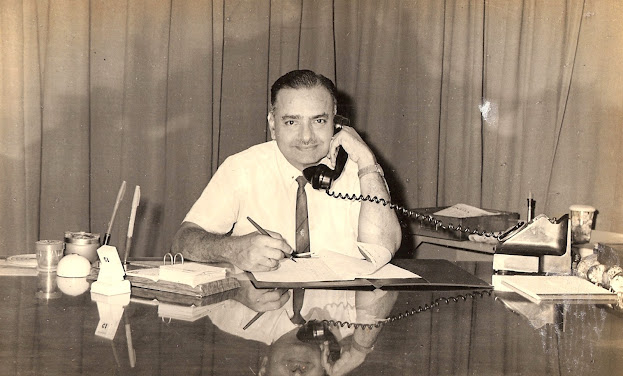
Sarma mavayya garu in his office

Pic Courtesy: Family members of Late E. K. Sarma

Until the next, 

Krutagjnatalu (Telugu), Nanri (Tamil), Dhanyavaadagalu (Kannada), Nanni (Malayalam), Dhanyavaad (Hindi), Dhanyosmi (Sanskrit), Thanks (English), Dhonyavaad (Bangla), Dhanyabad (Oriya and Nepalese), Gracias (Spanish), Grazie (Italian), Danke Schon (Deutsche), Merci (French), Obrigado (Portuguese), Shukraan (Arabic and Sudanese), Shukriya (Urdu), Sthoothiy (Sinhalese) Aw-koon (Khmer), Kawp Jai Lhai Lhai (Laotian), Kob Kun Krab (Thai), Asante (Kiswahili), Maraming Salamat sa Lahat (Pinoy-Tagalog-Filipino), Tack (Swedish), Fa'afetai (Samoan), Terima Kasih (Bahasa Indonesian) and Tenkyu (Tok Pisin of Papua New Guinea), Malo (Tongan), Vinaka Vaka Levu (Fijian)


Hemantha Kumar Pamarthy

Chennai, India

Friday, 11 February 2022

Hemantha Kalam - 99 " The Happy Story of 'Sad Hill' "

What happens when you stumble upon some 5000 graves in a place which has been forgotten by the creator, and as the creator himself is not around anymore?

**********

You dig them in curiosity and find that not a single grave has a body interred into? You think the plot is thickening?

**********

To know answers to these questions we need to go to Almeria, Arlanza valley and Burgos etc., in Spain or watch the docu-film ‘Sad Hill Unearthed (2017)’ on Netflix. If you have decided to watch the film you need not waste your time in reading this blog any further.

Well, we Indians know what it is all about film ‘Hero’ worshipping. We have cases where temples have been built for the actors in India and people have mass prayers conducted when one of their favourites is sick or on death-bed. You think such acts are bizarre? Then you don’t know even half the story!

Trust me; sometimes the westerners, in their own way, also worship the ground the film stars walk. This is one such interesting story. If you are interested, I welcome you to join me in unravelling this interesting saga.

During the early 1960s the Italians wanted to create western (cowboy oriented etc.) films in Europe, which, over a period, came to be known as spaghetti westerns that bred stars like Clint Eastwood, Eli Wallach, Franco Nero, Lee Van Cleef, et al. There have been such good and entertaining action films like the Companeros, Django, the Dollar Trilogy {A Fistful of Dollars (1964), For a Few Dollars More (1965) and The Good, the Bad and the Ugly (1966)}. Among these, by far, the film ‘The Good, the Bad and the Ugly’ attained a cult level.

As per ScreenRant (https://screenrant.com/the-good-the-bad-and-the-ugly-ten-things-still-hold-up-today/amp/) 10 things that still hold up today about ‘The Good, the Bad and the Ugly’ are;

1. Clint Eastwood’s ice-cool turn as ‘The Man with No Name’ (“The Good”)

2. The perfectly edited finale

3. Tonino Delli Colli’s breathtaking widescreen cinematography

4. The scope of ‘The Civil War Battle’

5. Eli Wallach’s endearing performance as Tuco (“The Ugly”)

6. The satirically exaggerated violence

7. Telling a simple story ‘On An Epic Scale’

8. Lee Van Cleef’s menacing performance as ‘Angel Eyes’ (“The Bad”)

9. Ennio Morricone’s operatic score

10. The trio’s introductions

However, though ‘The Good, the Bad and the Ugly’ might be seen as a Clint Eastwood’s film, in my opinion, it was clearly Eli Wallach’s and Ennio Morricone’s! In fact, at the time, Ennio Morricone’s score was considered as the second best music score in the world in a hundred years of cinema. No wonder, the title score is a hot favourite, even today, across the world.  

These films also brought out hidden talents and there have been some very well known film directors too. One among them who became a film giant of the times was Sergio Leone (1929-1989)!   

It appears that Sergio Leone spent a lot of time, money and energy in creating the venue for the climax and it is believed that a small or large part of the Spanish Army also might have participated in the shoot.

Sometime during the year, around September or about two months after the film shoot completed, another part of the Spanish Army unearthed a huge graveyard in Mirandilla Valley, Burgos, Spain. That cemetery had over 5,000 graves ...with crosses even, but no one buried in them. They also could find many a building that included trenches, dugout mini canyons, tented city, concentration camps etc.

The place lay forgotten for almost half a century buried under some seven inches of dirt and soil, till, as Netflix announces, “an eclectic group of fans of 1966’s ‘The Good, the Bad and the Ugly’ attempted to restore the cemetery set in Spain where the movie’s climax was filmed”. The Fans grouped themselves as ‘Sad Hill Cultural Association’.

The Association, comprising of fans mostly from Spain, raised funds among themselves and also apparently via crowd-funding resources too. The members went to the spot, cleaned ‘the cemetery’ and restored the surroundings. And on the ‘D-Day’ they wore Special T Shirts and some even wore Ponchos like Clint did in the movie and took photographs! A dramatic group, from among the members, replayed the climax of show down between the three main characters. Then they had watched a special show of the movie that they arranged at ‘the cemetery’ and tried to live a day, the days of ‘The Good, the Bad and the Ugly’.

Well, what a way to pay a tribute and an ode to not only the film and the entire crew of the original film, but also to the location of the epic climax scene!?

As the film director Alex DE La Iglesia said,

“Cinema takes you to impossible places                                                               Cinema means being in places you could never be in real life!”

But the efforts of this group proved that, what has been created and forgotten can be recreated not just for the sake of nostalgia alone, but also as reverence to the art and the artistes.

Well, you can’t agree more! Do you? Do write to me, please!

Until the next, 

Krutagjnatalu (Telugu), Nanri (Tamil), Dhanyavaadagalu (Kannada), Nanni (Malayalam), Dhanyavaad (Hindi), Dhanyosmi (Sanskrit), Thanks (English), Dhonyavaad (Bangla), Dhanyabad (Oriya and Nepalese), Gracias (Spanish), Grazie (Italian), Danke Schon (Deutsche), Merci (French), Obrigado (Portuguese), Shukraan (Arabic and Sudanese), Shukriya (Urdu), Sthoothiy (Sinhalese) Aw-koon (Khmer), Kawp Jai Lhai Lhai (Laotian), Kob Kun Krab (Thai), Asante (Kiswahili), Maraming Salamat sa Lahat (Pinoy-Tagalog-Filipino), Tack (Swedish), Fa'afetai (Samoan), Terima Kasih (Bahasa Indonesian) and Tenkyu (Tok Pisin of Papua New Guinea), Malo (Tongan), Vinaka Vaka Levu (Fijian)


Hemantha Kumar Pamarthy

Chennai, India


Sunday, 1 August 2021

Hemantha Kalam – 98 “The 'Parambarais' of North Madras”

I was a boy of about eight or nine years old when one day my father came home early, took a bath and dressed casually, helped me dress like a dude (he always ensured that I was dressed like a dude – a habit that stayed with me, when I want to). Immediately I knew that he was planning to take me for an outing. Those days I was quite timid and preferred not to go out much. But then I realised much later that a day out with my father was always an education.

So, this time he said “come, let’s take a walk”. My father was tall and his stride was large. I was short, small and so my stride was very much shorter and I had to sprint a bit to catch up with my dad or he had to catch up with me by slowing up, which he used to do mostly. I am not reputed to be a great walker (except while schooling and on route marches).

After about 10 minutes of walk we reached the ‘Congress Grounds’ in Teynampet, Madras which was just three streets away from our home then. There, at the entrance, I saw the huge cut outs and wall posters announcing a wrestling match among the legends Dara Singh, King Kong, Ajit Singh and some lesser known wrestlers of the day. My father got the tickets (it should be rather just a ticket, in singular, as I was let in free, as I was just a boy). If my memory serves me right, the cost of the ticket per head was something like Rs.10 for a ringside view in cane/rattan sofas, Rs.5 for sitting in foldable chairs, Rs.2 for a gallery seat (made up of casuarina poles and wooden planks) and Rs.1 for standing and viewing. We found a vantage place in the makeshift gallery, where the view was reasonably clear for me.

When the bell rang and the game started first among lesser known wrestlers and then the renowned wrestlers, my father got involved rather animatedly like the frenzied mob all around us. I was scared each time there was a wrangle but slowly I too got drawn into the game. Trust any father taking his small son to wrestling and boxing matches like my dad did. But it gave me a closer look at the game – rather a ring side look at that! And that day onwards I had a deep respect for Dara Singh.

I don’t remember much of the boxing games as those used to take place mostly at the Nehru Stadium and/or at Kannappar Thidal (Kannappar Ground) near Madras Central Railway Station from where one may safely call Madras as North Madras. I think I remember watching the game of one of the renowned boxers of the day; one Mr. Bhakthavatsalam. Here also the initial bouts were between upcoming boxers first and then among the real pugilists of the time.

Both Nehru Stadium and Kannappar Thidal are landmarks of Madras that are still around. Only that the Kannappar Thidal has been handed over to Chennai Metro for dumping excavated material etc., while laying the Metro Rail transport in the city. While Nehru Stadium was mostly used for sports purposes, Kannappar Thidal was a multi-purpose ground that was being used for foot-ball games, boxing bouts and also circuses. Congress Grounds were also used for boxing bouts but very rarely though.

The Madras Boxing history should, perhaps, be at least a century old. It has thrived well mostly in the Tiruvottriyur and Choolai areas of Madras. The players were mostly fishermen or workers working as loaders, on odd jobs or in the Madras Port and thus not economically a well-to-do people.

The indigenous sport restricted the boxers to hit only on the face and nowhere else on the body. However, the British who had influence on their workers slowly taught them the British mode of boxing which allowed the pugilists to hit not only on the face but on the body too but only above the midriff. So the boxing matches used to announce the bouts as “Rosamaana Aangila Kuththu Sandai” (Ferocious English Boxing).

The boys and men used to continuously train under some renowned teachers and each teacher is a legend in his time. So between 1960s and the 1970s there appear to be at least four well known ‘Parambarais’ or clans (I prefer to use the word legacies) in North Madras area. First ones, apparently, were the ‘Idi Appa Naicker Parambarai’ and ‘Ellaiappa Chettiar Parambarai’. Idi Appa is a moniker as his punch used to be like a thunderbolt (Idi). Soon the name became Idiappa Parambarai.

Over a period, there came into being another couple of legacies called ‘Saar Patta Parambarai’ and ‘Chunnaambu Kulam Parambarai’. Saar Patta is the Moniker and the root is four knives (Chaar Pattaa Katthi) as the punch of the pugilists belonging to this legacy equalled the pain caused by four knives. This finally came to be known as Saarpattaa Parambarai. The Tamil Chunnaambu Kulam means Lime Pond or Lime pit. Historically it appears that, over a period, the Ellaiappa Parambarai and Chunnaambu Kulam Parambarai merged with the existing legacies and Saarpattaa Parambarai and Idiappa Parambarai became renowned as rivals and vied with each other for the honours to be the numero uno.   

It appears that as political connections grew and the bouts fetched money to the organisers and some winners only, many boxers found no significant wherewithal for themselves and began to stray waywardly. Some became the henchmen for moneylenders and a few of them even rowdy elements. It is sad when you come to know that a few boxers who had their sunshine days are reduced to sell vegetables in Choolai market these days.

Thus the recently released Tamil film ‘Sarpatta Parambarai’ piqued my intrigue and I wanted to see if I can relive my memories associated with these manly sports. I have to say with much satisfaction that the film did not disappoint me.

Though quite lengthy at 173 minutes (for, any film that is more than eight minutes it becomes difficult to hold my attention these days) and made as a period film (the 1970s) the picture is, indeed, a treat. One doesn’t get bored even for a minute. It is like a book that you do not feel like putting down. The screenplay is quite tight and I could easily relate with the context and the language of the conversation and dialogues.

Something interesting I found from the film was the use of some Telugu words by the members of the legacies; words like “Gelichiduven” (‘geluchu’ means to win, in Telugu), “pilaka” (in this context short form of Pilla kaaya, a word for a kid that is used in the bordering districts of Andhra Pradesh) and “Thotha” (to be pronounced as ‘thodha’ again a corruption for ‘Thodu’ in Telugu which means a companion).

When I tried to do some quick research I came to understand that as over a period of time these legacies were supported or patronised by political parties several hues were applied to the sport and there even has been an un-proclaimed ban on the sport. It was in those times that the interested kids were sent to Boxing trainers in Andhra Pradesh for training. This, in itself, was news to me as I never heard any news of boxing in Andhra Pradesh excepting in Hyderabad (now a part of Telangana) and Visakhapatnam. It was a surprise for me to note that there are several boxing coaching centres in Chittoor district of Andhra Pradesh bordering with Tamil Nadu. 

Coming back to the film, one has a satisfaction of watching a good film at the end and that everyone in the project did their best to excel. The picture also depicted the effect of emergency on boxing in Madras with many of them treated as political persons and jailed.

As far as I am concerned, the characters of ‘Dancing Rose’ and ‘Daddy’ would linger for a long time in my memory. Apparently there was no Dancing Rose in the history of Madras Boxing and it was adapted on the basis of Prince Naseem Hamed, a boxer of repute from UK. This was played by Mr. Shabeer Kallarackal who has performed with élan and it was a joy watching him don the ‘Dancing Rose’ role. It is said that Shabeer though had taken a reference of Prince Naseem Hamed, he introduced his own style of dancing in the ring which was quite pleasant to watch. So did Mr. John Vijay as the Anglo Indian ‘Daddy’. His way of speaking was just like the Anglo Indians, quite a few of whom I knew well.

I couldn't help noticing a couple of inconsistencies though. One is that the clock at the boxing ring lost its continuity during the bout between ‘Kabilan’ the protagonist and the ‘Dancing Rose’. At one point, the clock shows 5.04 minutes (at 1:15:19), next it shows 5.15 (at 1:16:04) and again after a few frames the clock goes back to near 5.05 (at 1:16:24). Apparently the clock has been inspired by ‘Dancing Rose’ that it also waltzes back and forth. Surely, when it is mentioned that there were only 30 seconds for the round to close, 10 minutes could not have elapsed. Apparently someone in the charge of continuity goofed on this. If possible the shot showing the clock at 5.15 could be removed. Similarly, on the one old red bus that was shown a few times, there also should have been the Tamil words “Pallavan Pokkuvaraththu Kazhagam” {Pallavan Transport Corporation (PTC as it was dearly referred to)}.

While these are but two tiny inconsistencies, the film overall was excellent. Not once would one feel that they are watching a movie but the actual boxing scenes and the background realities. Each and every member of the team toiled to that extent and succeeded well. That the film was made during the pandemic of COVID-19 and still withstood the impediments is a point to be lauded.

A good film well made. Congratulations to the entire team!     

My only regret is that it came at least five years late for me. Though it did help me to relive my memories (the transportation to the 1970s was complete), it deprived me of the pleasure to watch this film along with my dad. Had it been released in 2016, both of us could have reminisced together with my father’s memories put in for a good measure. And I have no doubt that he would have been regaled in watching the film.

So, until the next,  

Krutagjnatalu (Telugu), Nanri (Tamil), Dhanyavaadagalu (Kannada), Nanni (Malayalam), Dhanyavaad (Hindi), Dhanyosmi (Sanskrit), Thanks (English), Dhonyavaad (Bangla), Dhanyabad (Oriya and Nepalese), Gracias (Spanish), Grazie (Italian), Danke Schon (Deutsche), Merci (French), Obrigado (Portuguese), Shukraan (Arabic and Sudanese), Shukriya (Urdu), Sthoothiy (Sinhalese) Aw-koon (Khmer), Kawp Jai Lhai Lhai (Laotian), Kob Kun Krab (Thai), Asante (Kiswahili), Maraming Salamat sa Lahat (Pinoy-Tagalog-Filipino), Tack (Swedish), Fa'afetai (Samoan), Terima Kasih (Bahasa Indonesian) and Tenkyu (Tok Pisin of Papua New Guinea), Malo (Tongan), Vinaka Vaka Levu (Fijian)


Hemantha Kumar Pamarthy

Chennai, India

Sunday, 25 July 2021

Hemantha Kalam - 97 'Emotional Locos'

I got down from the local electric train at Mambalam station, to meet my friends and go ahead to college together with them. I couldn’t meet them yet and so was loitering on the platform. Meantime several trains came and went, the frequency being about one each every five minutes or so. One train just stopped on the platform and an old gentleman was seen sprinting down the staircase. In 1974, escalators or elevators were unheard of in many railway stations in India. By the time he neared the train, the train started moving out and he shouted ‘hold-on’ but the train, as is wont of it, did not wait and continued. He was our revered English professor Sri Devanathan. He was quite frail and that he had sprinted on the stairs itself must have exerted his energies. He had a sheepish smile at some of those students of his, which included me, who were present on the platform and witnessed this humourous happening.  We had a good laughter, the whole day, thinking of this ‘funny’ episode.

The point to be made and understood is that trains don’t stop (or at least not supposed to) for frivolous reasons except in accordance with their schedules, er if they follow them (well, I am referring to our Indian trains mostly, in this case).

My college was about 12 kms or eight miles away from my residence. So every day I used to pedal and go by the bicycle to Kodambakkam station (which was about three kms from home) leave the bicycle in the station’s cycle stand and do the rest of the journey by local electric commuter trains. In between, there were some four stations. Later with the introduction of an additional intermittent station they became five stations. On the very first day of my joining, the college had some protest demonstration and many of us students were forced to return home without attending to classes.

On the second day, I attended classes, careful not to be caught by seniors who would trace juniors and rag them. So during the lunch time, I preferred not to go to the college canteen for the fear of becoming a ragging victim and instead, silently eased out and went to the station to take a train to Mambalam hoping to have lunch in a restaurant there.

The train was moderately crowded but I was lucky to find a place near to a window. During the motion of the train, I suddenly found a big kite like thing flailing across the window and falling with an inaudible thud. The train stopped in a few seconds; an unscheduled stop. I came to know that someone fell out onto the ground from a doorway of our moving train and was grievously injured; and his chances of survival were rather grim. That was the first train accident I came across and the first time I saw a train coming to an unscheduled halt.

With the advent of technology came the YouTube and thanks to that we can see many wonders across the world. It is as if the world is, indeed, in our palm.  

We saw trains going through slums in Delhi, India (https://www.youtube.com/watch?v=zSzt3RAdDds); residential areas in Hanoi, Vietnam; and through a market in Maeklong, Thailand (https://www.youtube.com/watch?v=o1KkXDZ2kCk).

There has been a case of several trains coming to halt at a time because an assistant station master was found to be apparently drunk on duty (https://www.youtube.com/watch?v=-fqhMRGy3mk).

A more hilarious wonder was a train stopping at a level crossing where the Locomotive’s engineer went to a nearby shop to buy his breakfast. Till he got the food packed and returned, the hapless road users were stranded on the road waiting for the level crossing gate to open up (https://www.youtube.com/watch?v=tZxO6H6Qt5E).

But very recently I came across a video clipping where an engineer had the warm heart of sopping a train, even after starting on its scheduled journey, so that a hapless aged traveller could board the train. He ensured that the traveller boarded before moving the train. It’s a heart warming video clip, indeed! (https://www.youtube.com/watch?v=GNkfe4HXEJM)

So when you think that trains are mostly brawns and no heart, think again. After all, locomotives have emotions too! J

What do you say? Well, until the next,  

Krutagjnatalu (Telugu), Nanri (Tamil), Dhanyavaadagalu (Kannada), Nanni (Malayalam), Dhanyavaad (Hindi), Dhanyosmi (Sanskrit), Thanks (English), Dhonyavaad (Bangla), Dhanyabad (Oriya and Nepalese), Gracias (Spanish), Grazie (Italian), Danke Schon (Deutsche), Merci (French), Obrigado (Portuguese), Shukraan (Arabic and Sudanese), Shukriya (Urdu), Sthoothiy (Sinhalese) Aw-koon (Khmer), Kawp Jai Lhai Lhai (Laotian), Kob Kun Krab (Thai), Asante (Kiswahili), Maraming Salamat sa Lahat (Pinoy-Tagalog-Filipino), Tack (Swedish), Fa'afetai (Samoan), Terima Kasih (Bahasa Indonesian) and Tenkyu (Tok Pisin of Papua New Guinea), Malo (Tongan), Vinaka Vaka Levu (Fijian)

Hemantha Kumar Pamarthy

Chennai, India

Wednesday, 14 July 2021

Hemantha Kalam - 96 "Melancholic Sin'

The year must be 1965 or 1966. There were two more girls before me till I could get my turn. I was a runt of a boy doing my III standard, if I got my counting right, and was waiting in the queue to participate in the annual singing competition, in my school. The venue to sing was not on a dais but in the room of the school’s manager, an unnerving person.

After an eternity, which was no more than 10 minutes, I got my chance. I had to fold my hands in humility and obeisance, to the school’s manager Late N. S.  Sarangapani, and sing. I started singing one of my father’s favourite songs “Ee visaala, prasaanta, ekaanta sowdhamlo......” (in English, it freely translates into ‘in this spacious, peaceful, desolate mansion.....’), which was a private song sung by Late M. S. Rama Rao, a renowned singer in the Telugu devotional and film sectors.  

My father helped me practice well for proper tuning, pronunciation, diction, appropriate spacing and word breaking. As a matter of fact the original of this song is rather sober, but my father made it more mellifluous and trained me to sing that way.

Like he used to do always, he held me in his hands and used to make my head rest on his shoulder while strolling in the house compound and singing melodies of Ghantasala, Hemant Kumar, Mohammed Rafi, Talat Mahmood and others, to make me sleep.

That’s how it was engrained into my system that I could not only appreciate melodies that were sung even before I was born but also try to sing a few of them. That my grand uncle was a well known music director also helped, as I was mostly in the music atmosphere. 

Coming back to the present story, I thought I sang the song well. After all, my name and my family name were at stake and I had to keep the flag flying high (well, ours is a family of music and dance – My paternal great grandfather taught dance to the famous south Indian film actress Savithri). But dear Sarangapani hardly bothered about all these finer aspects. Apparently no song and dance jigs for him. Perhaps, I realise now, that he could have been a staunch follower of Subrahmanya Bharathi who famously said “Yaamarintha mozhigalilae tamizh mozhi pol inithaavathu engum kaanom...” (among the languages known to us, we won’t find a language as sweet as Tamil anywhere).


He randomly selected three winners, all who sang in Tamil, and that was that. I lost out. It was only then and recently that my singing was outright rejected, when one of my colleagues said that she can’t stand my singing even if I hum under my breath. Otherwise I guess my singing in general was at least bearable and approved, even if not liked.

As far as the contest was concerned, the school had multi lingual students from almost all regions of India and multilingual songs were sung on the day. But no, Siree! No chance for the others. The school was guided by a gentleman called Thomas Richard Duncan Greenlees (1899-1966 -https://en.wikipedia.org/wiki/Duncan_Greenlees), a South African, as the Principal/Head Master/Correspondent; yet dear Sarangapani ran the school on his terms. At least his dressing and mannerisms terrified the students so much that for all of them he was no less than a despot. Whereas Duncan Greenlees made himself a darling of all school children.

In this case, Sarangapani was the jury and the judge and the verdict came out swiftly. I was in absolute tears. I knew that I sang well. The song was also good. It was so good that a good 35 years later, O.P. Nayyar used this private song in a Telugu film called ‘Neerajanam’ (1988 - https://www.youtube.com/watch?v=zK4E6fAt3JA).

This was in the morning session. The whole bitter episode spoiled my appetite. When my father brought me lunch I broke down before him and told him that I sang well but did not win. He had this lovely smile on his face and he said “don’t worry, the others must have sung better than you. Let’s practice more”. So we kept singing together at home and used to enjoy life as it came to us. This helped me in future too.

Sometime during the time when I was doing my X standard, I got an opportunity to sing before an audience of hundreds of students. I started with the Tamil film song “Nalla perai vaanga vendum pillaigalae...”. After the first stanza, I got the jitters of the crowd and forgot the rest of the song. Hooting and catcalls started. Unfazed, I refused to get down, but then I could not remember the song either. The teachers were gesticulating to me to get down from the stage or else...! One of my ingenious friends quickly gathered his wits and scribbled the full song in a hurry and tried to pass it on to me. I didn’t want any of that. Either I sang on my own or let the others suffer. Suddenly I remembered the next words and sang the song fully and well to a loud and long applause. That I got good from my teachers later, for this circus, was another matter though.

A couple of years after, in one of the cultural programmes organised in an institution, I started singing a Hindi song “Mera jeevan kora kagaz kora hi rah gaya...”. Halfway through I felt that my legs became jelly and I couldn’t stand any more. I pulled a chair on the dais to sit down and continue singing.

If my grand uncle was alive, perhaps I would have attempted to make a go at singing for films under his tutelage, for whatever it was worth, but he died at a rather early age and I never wanted to approach others or have anything serious with the film industry. I had always been a bit of Laissez Faire that way. So I kept aloof and satisfied myself singing songs in Karaoke sessions where people seem to like my singing and where I am not shooed and shunned off!

My dad’s taste in music ranged from listening to D. V. Paluskar to the antics of Kishore Kumar. He was singularly in love with the music instrument Shehnai and adored it (which I abhor) and Ustad Bismillah Khan was his musical God.

My father used to love “Ab tere siva kaun mera Krishna kanhaiya...” from Kismat (1943) as much as “Laara Lappa Laara Lappa...” from Ek Thi Ladki (1949). He loved the songs “Sar Jo tera chakraye...” from Pyasa (1957) and “Ai dil hai mushquil jeena yahaan...” from CID (1956) which he even taught my daughters to sing.

His favourites included Hemant Kumar’s “Vande mataram...” from Anand Math (1952), “Man dole mera tan dole...” from Nagin (1954), Talat Mahmood’s “Ai mere dil kahin aur chal...” from Daag (1952) and “Jayen to jayen kaha...” from Taxi Driver (1954).

Even while on death-bed, he was reminiscing his own memories associated with these songs and one night he suddenly described a scene and asked me whether I remember the song and the name of the film which escaped his memory. I said I did and softly sang “Raat ne kya kya khwaab dikhayi...” from Ek Gaon ki Kahani (1957) for him.

His Telugu favourites included “Pushpa vilaapam”, a private song sung by Ghantasala and written by Karunasri (Late Jandhyala Papaiah Sastry). His Telugu film favourites included “Taa dhimi taka dhimi tolu bommaa...” from Bangaru Paapa (1955) an adaption of Silas Marner and “Evaru chesina karma vaaranubhavinchaka...” from Keelu Gurram (1949). 

But I used to love more of his singing the Telugu song “Ee visaala, prasaanta, ekaanta sowdhamlo...” in his own melodious tune and voice. I even dare say, without any hesitation, that his rendering of this song was much better than that of the original. It seems to have come so naturally to him (even when he was singing songs it was rare to see him practice at home).

The biggest sin is that I had never recorded him singing this song, despite having recording devices at home since 1979. In fact, I never even thought of recording any of my father’s songs ever. At least my wife made him sing a song in the end but it was only a consolation to his original melodious voice.

Alas, it is too late now as it has been over four years since he passed away on this day, the 14th July, in 2017. If only I have the power of travelling back into time or to have a device to rewind time to bring him back! I do hope that he is able to sing to his heart’s content wherever he is now. Santhi santhi santhihi!

Well, until the next,  

Krutagjnatalu (Telugu), Nanri (Tamil), Dhanyavaadagalu (Kannada), Nanni (Malayalam), Dhanyavaad (Hindi), Dhanyosmi (Sanskrit), Thanks (English), Dhonyavaad (Bangla), Dhanyabad (Oriya and Nepalese), Gracias (Spanish), Grazie (Italian), Danke Schon (Deutsche), Merci (French), Obrigado (Portuguese), Shukraan (Arabic and Sudanese), Shukriya (Urdu), Sthoothiy (Sinhalese) Aw-koon (Khmer), Kawp Jai Lhai Lhai (Laotian), Kob Kun Krab (Thai), Asante (Kiswahili), Maraming Salamat sa Lahat (Pinoy-Tagalog-Filipino), Tack (Swedish), Fa'afetai (Samoan), Terima Kasih (Bahasa Indonesian) and Tenkyu (Tok Pisin of Papua New Guinea), Malo (Tongan), Vinaka Vaka Levu (Fijian)


Hemantha Kumar Pamarthy

Chennai, India