Friday, 2 September 2016

Hemantha Kalam - 38 'Virtually' Dead - Really 'Alive'

Well, I am one of those who do not hesitate in taking pride of being a technical noob and saying so! This belligerence emanates probably from the reason that I am born and brought up in times of almost ‘nil-technology’ (well, so to say in today’s parlance) and was happier. Most importantly, I survived to write this now.

So I was one of those who have been very reluctant to have a hand phone (call it cellular or mobile phone too, if you wish) and am always looking for an opportunity to get rid of one; soon as I hang up my boots for good and done for!

I have been quite happy with the simple instruments that I have been using but my first daughter, who is a sort of a gadget freak, felt that I do not possess an instrument befitting my professional stature (whatever it is). So there was this one time when I had to reluctantly go in for quite an advanced model (for that time) of Nokia, shelling out a small fortune and after using it for over 6 years it died naturally. By the time it died, I did not know functions other than storing my contact details, making and receiving calls, sending and receiving Short Messaging Texts (SMS) and filing them in folders and an occasional clicking of a photograph. I was given to understand that that machine had some infinite functions, but till the end of its life, I was as ignorant of them as I was - before having it.

Then I got my Nokia Asha 200 model and I was quite happy with it. But soon all hell broke loose in the form of ‘Apps’ – an app for this and an app for that. Still I was untouched by them. But then as I do consultancy work for my daily bread, I needed to work with my client, represented by a very young gentleman who swears by technology – even in his deepest slumber. He was virtually nagging me to go in for a more advanced system! Apart from interacting officially, this interaction became a part of our daily communications.

And when it came to hiring cabs through aggregators the rules of the game changed. Slowly one after the other, the cab aggregators stopped taking in calls for requesting cabs and started asking to download the apps and hire the cabs. Now my poor Nokia Asha 200 was not apparently meant for those myriad useless apps and so it did not support any or hardly any apps.

Every month there were times when I needed to hire a cab and I had to depend on somebody, mostly my wife, who is technologically more advanced and sophisticated than me, for booking my cabs for me. Though she always obliged me for this chore, without a protest, apparently it was becoming more and more of an inconvenience for her. So she and my daughters conspired and got me an Android phone! The purchase was ‘on-line’ - again using technology!

One fine afternoon, the ‘damned’ thing was delivered to me and I changed my sim into it and first thing my wife made me do is downloading the apps for the cab aggregators and the ‘WhatsApp’!

My wife’s circle is larger than mine and many of them are in ‘phoren’ countries or visit ‘phoren’ countries from India, as they have a son there or a daughter here and so on. Most of these people inevitably land up in the US of A, as many Indians seem to have made the US of A, an ultimate and must attainable destination in their life. I do not know what is in store for me as I am having children of marriage age and it is anybody’s guess where they will land up!

Well, coming back to the point, since the time difference could be as much as 10.30 hours between India and the west coast of US of A, some of these visiting characters will wake up in the morning and after having a sumptuous breakfast and sending their children to offices, would hardly have any work. They fill their time by systematically forwarding the ‘sermons’ and general gossip on ‘WhatsApp’ as if it is a vow and must be fulfilled on the pain of some deprivation. Now the problem is that the receiving time in India would be bedtime, due to the time difference. There have been any number of times I felt like telling all those characters to ‘shut up’ the ‘WhatsApp’ as it disturbed my sleep and the worst thing was the alert sound of a message. The signature sound of the ‘WhatsApp’ alert can really be irritating; to say the least. How I loathe that sound, bah!

If you are connected to some groups and members of each group are connected to members in other groups, the network shortens and the same message is forwarded some 6-8 times within a few minutes, among all groups – and many a time you will be receiving the same message or ‘share’ or ‘forward’ from so many groups that you are connected to or a member in.

On one hand it drains your battery cell and you need to keep on charging the system and on the other hand you need to constantly remove the received messages to free storage space. And then the answer came in the form of power banks which was another expense.

And what are you getting, for all this trouble taken? You are getting messages which you hardly have any use for, and in any case, most of them are ‘sermons’ which nobody follows but expects the others to believe that they do follow. Wastage of time, wastage of electricity and wastage of money! The only thing I enjoy are some good photographs and jokes through these ‘shares’ and ‘forwards’ and once in a way, some worthwhile information / news – Period!

Coming back to my mobile, it worked well for some time and then I had to upgrade to a 4 G micro-SIM! The moment I put it in, the mobile phone spewed it out and refused to read the SIM card. I took the system to a couple of service centres and nobody could diagnose the problem. Having bought the system ‘on-line’ and being a ‘technical noob’ I could not find an authorised centre. I also had lost the purchase invoice for the same.

Over a period of time, I got fed up and started using it only in my house where it got connected to the Wi-Fi internet, even without a SIM and thought that’s fine! But my dear wife could not allow good money to go waste and after skimming on the internet, latched on to the call centre and traced out three authorised centres in our city. One centre told me clearly that they will look only after the warranty period is completed and the service will cost money. In the other place, it took me a couple of days’ efforts even to connect on the phone and finally when I landed up at the service centre physically, they demanded the invoice which I did not have. However, one guy in the centre was pally and gave me the toll free number of the ‘On-line’ service provider and also added that till the time I provide the invoice my phone will not be attended to.

I was very skeptical in making the toll free call as I have been continuously bitten by the useless and faceless service many of the bankers offer in our country. But surprisingly this faceless girl was of immense help and sent me a copy of the invoice literally in less than a minute over my e-mail which I had forwarded to the service centre.

The service centre took a couple of more days to diagnose and finally declared that the “mother” (board) of my mobile is dead and they needed at least a fortnight to get the mother (board) replaced.

Let me tell you something. That fortnight had been heavenly for me.

When I got my mobile back after service, I was forced to again install several apps including ‘WhatsApp’ more for professional reasons and I noted that within about half an hour of installation, some 155 MB stuff has been downloaded comprising of some 3,000 messages from about 8 active groups (needless to emphasise that almost 90 MB of it has been sheer repetition). It took me some 3 days to go through the messages and to delete them – the pictures, the sermons and many useless videos.

And let me assure you that less than 0.5% of that stuff was relevant and there were hardly any business related information for all the trouble taken.

But worst – not a single inquiry, not a single wonderment as to why I was suddenly off the air! For all that mattered, I was ‘virtually’ dead for all the connections I had! Yes, there were a couple of murmurs, later when I resurfaced, that I was missed; but it was just that low key!

So ladies and gentlemen, for those 15 days maybe I was dead ‘virtually’ but I was so ‘alive’ really - in a true sense! No sermons, no useless sharing and sheer bliss!

I know I am day dreaming that people of my country will use mobile phones only for emergencies, as they were intended for – but, like hell, I can only dream!          

Well, folks, what do you think? Please, do let me know! Yes, I am still on ‘WhatsApp’ for whatever it is worth!

Till then, 

Krutagjnatalu (Telugu), Nanri (Tamil), Dhanyavaadagalu (Kannada), Nanni (Malayalam), Dhanyavaad (Hindi), Dhanyosmi (Sanskrit), Thanks (English), Dhonyavaad (Bangla), Dhanyabad (Oriya), Gracias (Spanish), Grazie (Italian), Danke Schon (Deutsche), Merci (French), Obrigado (Portuguese), Shukraan (Arabic), Shukriya (Urdu), Sthoothiy (Sinhalese) Aw-koon (Khmer), Kawp Jai Lhai Lhai (Laotian), Kob Kun Krab (Thai), Asante (Kiswahili), Maraming Salamat sa Lahat (Pinoy-Tagalog-Filipino), Tack (Swedish), Fa'afetai (Samoan), Terima Kasih (Bahasa Indonesian) and Tenkyu (Tok Pisin of Papua New Guinea).

Hemantha Kumar Pamarthy
Chennai, India


Monday, 9 November 2015

Hemantha Kalam - 37 "We are a 'Sound' tolerant people"

It is Deepavali now - A festival of Lights and Sounds. Yes, sounds of crackers (not the eating ones but the exploding ones) and fireworks. Children, growing and the grown, look forward to this festival for outsmarting the neighbours in the decibel levels.

We are basically a ‘Sound’ people, where we like to eat loud, belch loud, fart loud, talk loud, entertain loud, watch TV loud, drive loud and sleep loud!

Sounds appear to be the epitome of our way of life. Even when we talk on mobile phones, we are so loud, making the passersby a part of our confidential affairs and many a time I wonder whether this is done deliberately or out of ignorance. On watching our people using the mobile phones, for over 15 years, I had to come to the unscientific and unexplainable conclusion that many persons want to show off their abilities and status, whatever that might be, to others and get some superiority satisfaction out of that.

For many years, yours faithfully had been equally guilty of several of these qualities, especially in listening to music. That is till I started to really grow and started appreciating more and more of silence. And then my wife started blaming the cubicle culture in the offices to be the real reason of my drastic change towards sounds.

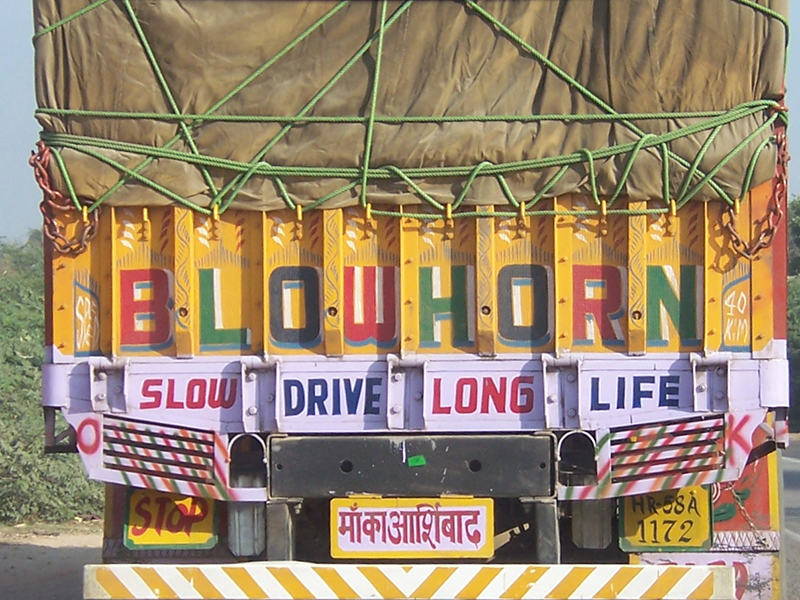
One of the questions, all my foreign friends and acquaintances on their first visit here, ask me is “why is it OK to horn” as that seems to be statutory and written behind almost all big vehicles.


They are more perplexed, especially, when there are requests to Blow Horn, as in many countries, honking is not tolerated at all. In almost all the countries I have so far visited ours is one place where the honking is incessant (I was driving in Thailand recently when the cab driver refused to honk even once saying that nothing irks the Thai driver more than honking from behind. He also mentioned of several incidents where drivers were shot by other drivers just for honking for two to three times. With the gun crime rate in Thailand allegedly equal to that of the US, this story sounded plausible).


The problem starts very early with us. For a long time, a majority of the population in the country could not afford a motor vehicle of any kind but always fantasized driving one. So the practice of making honking sounds with the mouth starts at a budding age where children chase one another running around and chasing each other, imagining to be driving a motor vehicle that suits their imagination. And there lies the country’s first problem. Even ultimately when they succeed in acquiring one vehicle or the other, the practice of honking by mouth gets transferred to be a reality and most of us just cannot resist such a wonderful opportunity of doing the ‘real thing’! 

There lies, probably, the answer to this part of the malady? Ban the children from making honking sounds by mouth!-Well? ;-)

But more practically, in a God Driven country, where most of the things seem to be moving and happening thanks to providence, the driving is an everyday adventure. When, people tend to stop in the middle of the roads to answer a mobile call or to chat with a ‘long last friend’ whom they have not met since the previous evening, or take sudden turns after waking from a slumber or enter / exit main thoroughfares nonchalantly as getting into one’s own house, other users always have to make their presence felt through continuous honking.

But when the ‘law reneging citizens’ wait patiently at red lights or at Zebra crossings to let the ‘no-good’ pedestrians live that day while crossing, the majority of the ‘law abiding’ road users impatiently keep honking nudging the people to move on.

I am not being a less patriot when I am writing this. I try to do my share by telling the youth, the light of the future of the country that if only they can be little more patient, things could be more comfortable.

But I guess I was barking at the wrong tree because, I find that the new generation youth really seem to be more concerned than the arrogant and mostly ignorant generation that immediately followed the independence period in the country.

As one of the youth was confiding with me (verbatim) ‘uncle, I would abide by the traffic rules and not honk, but who will tell the government bus driver, behind me, that I am abiding the traffic rules?’

Indeed, it is very common to see nowadays, that drivers of government buses in many states nonchalantly break traffic rules of any nature and seem to be driving more by blaring horns and terrorizing other road users, than by using the fuel. Thanks to trade unions, that crew members are affiliated to, no state government seems to be in a position to rein in them efficiently.

While I can empathise with the bus crew members of the troubles they undergo in maneuvering the huge vehicles on city roads that have been designed for periods that are a century behind, they also should realise that they do not always sit in the buses and that they too have to walk on the roads and the same fate can befall them when they are walking.   

But I am going astray and afar. Let me come back to Deepavali and the crackers. 

For the last few years a few states in the country, like Tamil Nadu, have imposed a ban on firing any sound making crackers after 10 pm. While I am writing this, it is well beyond that time and I am still hearing the city reverberating with the sounds of the crackers. In many households that cannot afford air conditioners, babies, the old and the sick suffer and take the brunt of this, most.

The celebrations with fire crackers in apartment complexes sometimes are pathetic. In one apartment there is a death and the family is mourning, but people in the other apartments continue with their merriment. So much respect for the dead and empathy for the bereaved!

But of course, even death is a matter of sound for us. There have been traditions where people {Oppaaris (Professional lamenters - for a payment - or genuinely out of grief http://www.umbc.edu/eol/5/greene/Greene_0.htm), Rudalis or professional mourners} sing loudly at the death. Even the hearse follows loud singing and dancing and yes bursting of crackers and fireworks on busy roads.

Music is doled out, beyond listening decibel levels, at festivals, weddings, puberty functions and what not. Some of the music played at the religious festivals can only be listened to than imagined for their gross impropriety, several times causing great amusement too.

In many states of the country, a whole industry thrives on this sound and cacophony.

Talking about religion, my apartment is juxtaposed between three religious places of worship, belonging to different faiths. One place starts chiming the clock, that can be heard around four streets, every hour, from 5-00 am till 10-00 pm; the chime followed by some religious sermon as per their religious book. At the other place, the devotees are called for praying at particular intervals of the day, through huge loud speakers. And then the other place of worship which virtually barricades the road, on which it is built up, at occasional festive times blaring inconsequential music and loud and many a time vulgar merry making, with not a least amount of thought to public or their convenience er inconvenience, so to say and forget about any devotion to GOD!.

This year, there has been a Bang er ‘Ban’ imposed on crackers from China being sold in the country, for much lesser prices. Well, I am certainly with my country on this as the native economy has to be encouraged.  

But then, now that the demand for crackers and fireworks is increasing thanks to functions that welcome ‘just released from jail’ criminals, politicians returning from attending parliament, election victories, celebrating the birth and death anniversaries of some persons who were born and dead before two generations, at places of worship and yes, nowadays, at weddings too, bursting fire crackers have become an everyday affair in the country, maybe the fear is far-fetched for the time being? 

I forgot to mention that bang opposite our apartment complex, we also have a wedding hall and when the bride groom arrives (at whatever auspicious time convenient to him - but mostly in the middle of the nights to save on cost of the venue that is charged on hourly/daily basis) crackers are exploded so loudly, that many people are disturbed from their sleep. 

Yes, there is a continuous demand for fire-crackers in the country and I am sure that in days to come it will increase too!

After all, we are ‘Sound’ people. And yet, we are dubbed as intolerant! Really?

(The following paragraphs are added when it has been brought to my attention that I had missed out on a couple of other 'Sound' related matters)

The Talk shows on our Television in any language but especially anchored by a couple of famous (or should one say notorious?) gentlemen, are mention worthy as everybody talk at the same time and in any case, except the anchors nobody else is allowed to complete their talk, leading to frustrating and yet hilarious situations almost every time, without fail. 

The second one is induced by technology. Most of the mobile users in the country are plugged with wired and wireless earphones not to miss the 'Sound' of music, 'Sound' of their "companion's" sweet nothings and many a time are oblivious to other sounds while walking and thus endangering themselves while travelling or walking. A few have lost their lives while crossing railways tracks as they could not hear 'Loud Hooting' of the train but only the sounds produced / relayed by their mobile phones! 

This goes to prove that we live by 'Sound' and die by 'Sound' and even after death are followed by 'Sound'

Well, folks, what do you think of this 'Sound' theory of mine? Please, do tell me! 
Meantime, a colourful and ‘Sound’ wishes for a Happy Deepavali!

Till then, 

Krutagjnatalu (Telugu), Nanri (Tamil), Dhanyavaadagalu (Kannada), Nanni (Malayalam), Dhanyavaad (Hindi), Dhanyosmi (Sanskrit), Thanks (English), Dhonyavaad (Bangla), Dhanyabad (Oriya), Gracias (Spanish), Grazie (Italian), Danke Schon (Deutsche), Merci (French), Obrigado (Portuguese), Shukraan (Arabic), Shukriya (Urdu), Sthoothiy (Sinhalese) Aw-koon (Khmer), Kawp Jai Lhai Lhai (Laotian), Kob Kun Krab (Thai), Asante (Kiswahili), Maraming Salamat sa Lahat (Pinoy-Tagalog-Filipino), Tack (Swedish) and Fa'afetai (Samoan).

Hemantha Kumar Pamarthy
Chennai, India

Thursday, 1 October 2015

Hemantha Kalam - 36 "Aging is Hell?"

“In youth we run into difficulties (and) in old age difficulties run into us.”
--Beverly Sills

I have been mulling on writing this piece for quite some time, but I felt I am still not that old and I can really wait. But it does look like old age is being thrust upon me – more by external forces than by the biological stages. Well, I am still on my journey and am waiting for more surprises.

But, as most of the times, a feature by Zubeda Hamid, in today’s The Hindu (http://www.thehindu.com/todays-paper/tp-national/tp-tamilnadu/dignity-of-life-still-eludes-the-elderly/article7709415.ece) on account of the ‘World Geriatric Day’, triggered my thoughts and coaxed me into writing this, a tad earlier than I wished to. So I prefer to make this pondering as Part-1 and a few years later, depending on many other considerations, I would endeavour to write more or differently maybe, and if I am around to do that.

The feature, in The Hindu, aptly says that ‘The ageing body finds relief, but not the weary mind’. The statistics reel out that the life expectancy, over 13 years, has increased by about 12% for men and by about 18% for women. This translates into longer struggles and deeper pain.

The breaking of the Joint Family system, in India, has quietly seen the withdrawal of the insulating systems, leaving everyone concerned coping with stress and anxiety. Work related stress spills over into the family life, rendering even small and insignificant incidents causing much abuse and again the statistics reel out that the abuse (disrespect, verbal abuse and economic exploitation) faced by the oldest (80+ in age) is manifold and the abuse borne by the women (at 53%) is much higher than the men (at 48%).
   
For most part of our youth we are answerable to our parents. Almost all our middle age is spent on being answerable to our ‘bosses’ – at office and / or at home. And the rest of the life seems to be answerable to our progeny – all in the name of affection, love and sacrifice. The hell, with it! When will we live life our own way, then?

A little boy, known to the family, apparently has his eyes on the clock and the calendar as he is in a hurry and wants to grow fast, so that he can be more on his own. Now, what a blunder it could turn out to be, if only he could realise it. The more independent one wants to be, the more regrettable the society makes the life for one.

A few years ago, while just entering into his 80s, my beloved father, in his mid-80s now, confided in me that he found ‘aging to be a hell’ I nodded my head in understanding and passed some remarks in empathy. 

He is quite an energetic man and loves to be in the company of people and spending his retired time either doing some household work or conversing with some neighbours or a visitor. He had been diagnosed with heart problems and at an age of 72 or so we, his children, made it clear that he cannot use his bicycle, his passport to freedom, anymore. He certainly was unhappy, but was gracious enough not to put up much of a resistance.

Ever since, he almost became a couch potato indulging in the soap operas, films and the various religious programmes beamed out by any number of channels, over the Television. Yes, he still religiously pores over two newspapers, in two languages, every day; help my mother with the household chores. But then there it is; he is bound to the house. His unhappiness increased when there has been competition for the viewing rights on the TV from other members of the family. So, seeking a change from the monotony, every time he meets a visitor, be it his own children or kith or others, his eyes light up!

Of late, when I myself started experiencing several constraints, mostly by external forces, I realise that I agree with him. When you start growing older, as Gabriel Garcí­a Márquez, said ‘What happens is that you don’t feel it on the inside, but from the outside everybody can see it’. My own mother often says that the aging is only to the body, but the mind, until one becomes senile, is eternally young.

First blow to me was, when riding my motorized two-wheeler was restricted or nearly banned, as that became a cause to worry that my ‘rash’ driving could endanger me or the others; this, when I hardly crossed 40s. Small mercy that I am still allowed to drive my car! So today, with the freedom of my mobility taken away, even to cover short distances, I either have to walk or jostle with sweating and stinking crowds in a public transport, because parking cars can be worse hell now. And other modes of transport is not friendly on the pocket.

Then came the restrictions on 'excesses' like watching TV, surfing internet, listening to music (old songs or gaudy songs, not suitable to be heard by persons of my 'age'), talking, eating (don't eat this, eat with less salt, no pickles etc. etc.,) and what not? All I see now are excessive restrictions J

And restrictions need not always be from the offspring. It can be from the ‘off-side’ (spouse) too. Yes, all in the name of love and affection J
  
No, I do not doubt the affection, concern and love because I am aware that it is all genuine and because the loss of their beloved could not be seen by them. And NO, I am not abused either as I am cared for, respected (I think) and surely there is no economic exploitation.  

But then, this is the time I was longing for and looking forward to, to do what I like to; to indulge in what I like, without much of a care or concern for job related pressures.

An old colleague of mine always used to say that he envied me for the amount of material that I had collected for my ‘retirement’. Yes I do. I have collected so much to earn the sobriquet ‘Kuppa Collector’ (Garbage Collector). Painstakingly, I had built a library but finally when I wanted to relax and read books while lying down because of spondylitis, my bifocals do not permit me to. So my daughter gifted me with her Kindle. Once I started using that, objections are raised that the light emitted by Kindle disturbs and destroys "the other's" sleep.  

I know I have reached that stage of life when if someone tells me to pull up my socks, I don’t need to J But increasingly I find that the restrictions imposed or ‘innuendoed’ cramp my space and that I am steadily constricted. And for a person who chafes at authority, nothing could be worser.  

If these are the thoughts of a person, who has to still cross 60, I am sure what my father felt and meant. Aging, indeed, seems to be hell! Yes, dear Dad, I agree with you totally.

After all of this, my advice to all youngsters is “do whatever you want to do now and do not wait till the ‘retirement’” which could finally turn out to be a damp squib, after all, and for no fault of yours except, damn it, aging!


Well, folks, what do you think? Please, do tell me! 

Till then, 

Krutagjnatalu (Telugu), Nanri (Tamil), Dhanyavaadagalu (Kannada), Nanni (Malayalam), Dhanyavaad (Hindi), Dhanyosmi (Sanskrit), Thanks (English), Dhonyavaad (Bangla), Gracias (Spanish), Grazie (Italian), Danke Schon (Deutsche), Merci (French), Obrigado (Portuguese), Shukraan (Arabic), Shukriya (Urdu), Sthoothiy (Sinhalese), Aw-koon (Khmer), Kawp Jai Lhai Lhai (Laotian), Kob Kun Krab (Thai), Asante (Kiswahili), Maraming Salamat sa Lahat (Pinoy-Tagalog-Filipino), Tack (Swedish) and Fa'afetai (Samoan).

Hemantha Kumar Pamarthy
Chennai, India


Thursday, 16 July 2015

Hemantha Kalam - 35 'Contrasts and Contradictions'

The news over the past few weeks was mixed and skewed more towards discomfort. And two photographs (appearing in the beginning and at the end of this blog) fed the content for this blog.


A Greek Pensioner Citizen Crying on knowing that he could not withdraw his weekly pension!

First, the Greek Crisis!

Much water has flown on this account and much has been written. With falling GDP rates, higher Government Deficits and low repayment capacity among others, the situation contrasted with the austerity methods proposed by the troika comprising of the European Commission (EC), the European Central Bank (ECB), and the International Monetary Fund (IMF). With ever polarising political and economic powers in the region, Germany, with its geo-economic power, stood firm on the austerity method.

The Greeks, who are used to comfortable entitlements such as education, healthcare, housing, pensions from early age and unemployment benefits, must have felt that the bubble would last forever and apparently did not ensure creation of a next generation of people to continue industrial productivity and thus increase the GDP. Left with hardly any other choice, the question looming large before the Greeks were European Union (EU) or Greece Exit (from EU) or simply GREXIT! Greece withstood the onslaught for the time being but the government has to face an imminent internal battle where the success is a big question mark.

As Mr. Sanjaya Baru wrote for ‘The Hindu’, imagine a similar Greece like situation happening to one of the weaker states in India. One realises, thankfully, that the Indian Union did not stop from being just an economic or a political union, but adopted the principle of federal financing. (http://www.thehindu.com/opinion/lead/sanjaya-baru-writes-the-greek-crisis-and-an-imperfect-eu/article7375465.ece)

But again contradicting the above, even in India, one can see the dilly dallying by the Central government in ensuring the promise of Special Status for supporting Andhra Pradesh, which has been split for political reasons, with not even an excuse of a referendum. While the carved out portion of the United Andhra Pradesh (UAP) is sitting pretty on the budget surpluses created by the UAP, the residual portion of Andhra Pradesh, with gargantuan deficits is being forced to receive just promises, but in effect is to fend for itself.

Talking of the Central Government, the intentions might be good like fostering good internal and external relations. While Prime Minister Shri Narendra Modi is trying to strengthen the country’s relations with neighbouring countries and those countries that matter, the internal problems of severe opposition for his travelling abroad frequently, the unending ‘Vyapam’ issue, problems facing the five women ruling party leaders being alleged of their roles in minor and major incidents and scams, etc., are contrasting this claim of building good relations and governance.

In the same Andhra Pradesh, the state government which believes and says it does, has empowered women DWCRA groups with the responsibility of fair distribution of river sand (which of late has become a source of high income for the mighty, and making any construction reaching the skies and stars), hoping that being women, they would be much more judicious and less corrupt in discharging their duties. Contradicting this belief, a group of DWCRA women had allegedly assaulted a Tahsildar, in the rank of Mandal Magistrate, again another woman herself, who was discharging her duties in preventing illegal quarrying and smuggling of the sand by a sitting minister of the State Government of Andhra Pradesh at the instigation of the same minister who allegedly came to the spot to ensure that his trucks and tractors of sand move out smoothly, in the cover of the night. 

And recently there have been reports of a man being booked on charges of commenting about women in a distasteful manner on the Facebook and the court is taking up the case to proceed in the matter suitably. Contrasting this, there was quite an amount of newspaper printed upon, on how a court has released a rapist on bail / parole so that he can go and mediate with the rape victim to marry him and so he can escape further penalising.

Contradicting the above are the successful and happy cases of women, like Ms. Sania Mirza who was victorious at the Wimbledon and that Chennai Metro Rail is being piloted by women – Ms. Preethi and Ms. Jayashree.

And when talking of the recently launched Chennai Metro, stringent rules are laid out that people may carry food in packets and boxes with them but they cannot use the train cars and stations for eating. Is this not a contrast, when elsewhere, in Delhi, there was this gentleman who blatantly and in face of a camera eased himself inside a train car by taking a pee? Not that I am recommending or supporting either!

The Chennai people appreciate the Chennai Metro Rail services, but with a protest right from the first day that prices are too high and that they should be normalised, or else…

While talking about prices and costs, the latest World Development Report (WDR) 2015 titled “Mind, Society and Behaviour’ seems to be suggesting that poverty is a state of mind and behaviour and hence behavioural economics should be applied in making the poor take on a positive behaviour. In other words, as Mr. G. Sampath’s article is titled “Teaching the poor to behave”, the poor should be taught to 'behave' such that the poor do not make any wrong ‘economic’ decisions? (http://www.thehindu.com/opinion/op-ed/teaching-the-poor-to-behave/article7368130.ece)

Now see the contrast! Poverty is a state of deprivation of most of the resources including basic / decent education. So, when the poor does not even have the means of filling his stomach, how does one teach the poor to behave, in any other way than being and feeling poor?

Well, then is it 'Mission Impossible' and we need to use the services of Mr. Ethan Hunt? 

Or is it that, that over the centuries, we, as people of different, ancient and neo-civilisations, have been continuously failing or floundering and that still “Might is Right’ and we continue to live in jungles following the rules of the jungle, especially the 'Survival of the Fittest' rule?

Have, we really come to that stage, where we realised, that we have to retreat and start from the scratch?

  
Please, tell me! 

Till then, 

Krutagjnatalu (Telugu), Nanri (Tamil), Dhanyavaadagalu (Kannada), Nanni (Malayalam), Dhanyavaad (Hindi), Dhanyosmi (Sanskrit), Thanks (English), Dhonyavaad (Bangla), Gracias (Spanish), Grazie (Italian), Danke Schon (Deutsche), Merci (French), Obrigado (Portuguese), Shukraan (Arabic), Shukriya (Urdu), Sthoothiy (Sinhalese) Aw-koon (Khmer), Kawp Jai Lhai Lhai (Laotian), Kob Kun Krab (Thai) and Asante (Kiswahili), Maraming Salamat sa Lahat (Pinoy-Tagalog-Filipino), Tack (Swedish)

Hemantha Kumar Pamarthy
Chennai, India


Wednesday, 1 July 2015

Hemantha Kalam - 34 'Educating Education'

I was a topper in school or at least one among the top three, till I was in my 8th Standard / Grade. Later, I was more interested in reading anything and anything, thus eclipsing my interest in the class books and work. And within 3 years, by the time I reached my Secondary School Leaving Certificate level (SSLC-11th Standard / Grade) , I fell down to the ranks of the just about average student. As I continued with my college education, my interests expanded into NCC and learning music and I fell down to abysmal depths in the college studies and it was, indeed, a struggle for me to complete my college education.

So much so, that after coming out of college, I confided with my father that I no longer wished to waste his money (with whose support I was continuing my education) and my time, in pursuing something which has, time and again, proved to be elusive for me. That later I did management courses on my own and did quite well is another story.

In retrospect, I think I did not do very badly in life though my foundation has been quite weak. Today, people, at least some of them, consider me knowledgeable if not educated – a small gratification.

All this was possible because I was given a chance, more than once, in fact. My failures were tolerated. But today, the educational scenario in the country seems to have so drastically changed that there is neither tolerance nor a chance seems to be given to those who cannot make it – by the standards set in (most absurd levels, in my opinion) by the schools, which are now more identical to factories.

So why am I talking about this today, several decades after I had completed my educational odyssey? A report in yesterday’s Telugu newspaper ‘Eenaadu’ (http://epaper.eenadu.net/svww_index1.php) triggered my thoughts and culminated into this lament that it is.

The news item says that many schools, especially those in the private sector, in Tamil Nadu, a state of south India, are not permitting the lesser bright and not so bright students to take their qualifying examinations by forcefully evicting them out of schools, at the 9th Standard / Grade for not performing up to ‘their expectations’. The rationale - the schools have taken up on themselves the onus to guarantee a 100% pass percentage.

The figures for the year 2013-14, provided by the news item, are that 1,169,110 students were admitted into the 9th Standard / Grade but out of them only 1,072,691 have been promoted to 10th Standard / Grade. If readers think that the balance 96,419 (8.25%) students have failed to make the mark in their 9th Standard / Grade examinations, they would be in for a surprise. The news item says that these students have been cajoled, coaxed or forcefully evicted from the school by giving them a Transfer Certificate even before they could face the 9th Standard / Grade examinations. No records show that these evicted students got admitted in any other school; as no school would be touching them with a barge pole.

Now, the saga continues. That among the 1,072,691 who entered into the 10th Standard / Grade, only 1,060,940 students were permitted to face the qualifying examinations leaving behind a further 11,751 students not permitted to take the examinations. So totally out of the 1,169,110 students, finally only 1,060,940 students took the examinations leaving behind 108,170 (9.25%) students to face their own fate.

The alarming point is that now the malicious disease seems to be spreading to the government schools as well.

As it is, with even the educated youth of the country facing lack of employability skills, leaving about 10% behind every year, just because they are unable to reach the ‘expected’ grade / efficiency levels, are not the educational institutions doing gross injustice to the children and also to the future of the country?

Is the government taking necessary actions to provide alternate education to these ‘deprived’ and evicted students? How efficient is that system. If that system is working, how come there is a genuine scarcity for skilled workers in various trades such as Electrical, Plumbing, Masonry and so on….?

All this reminds me of a fabled task I used to listen from elders to think out of box. The task is simple. Make a vertical straight line smaller than what it appears now, without erasing or painting or covering over it, blah blah blah. Many people fail and one smart alec simply draws another vertical line a tad longer than the one already there making the first one look smaller in comparison.

To me somehow the present education system looks a bit similar. You want to show only success so decimate the failures! What nonsense?

Again, what is the purpose of education?

Writing in the Campus Newspaper ‘Maroon tiger’ Martin Luther King (Jan-Feb 1947 ‘The purpose of Education’ Atlanta, Ga) said;

“Education has a two-fold function to perform in the life of man and in society:
the one is utility and the other is culture…………….

…The function of education, therefore, is to teach one to think intensively and to think critically. But education which stops with efficiency may prove the greatest menace to society. The most dangerous criminal may be the man gifted with reason, but with no morals.”

In the recent years, running behind the so called ‘efficiency’ which anyway seems to be quite questionable, as our education system seems to be based more on the rote system, aren’t the citizens losing their right to education and a proper one at that?

What will happen to the 10% who are denied of their education year after year? If they cannot get admission in any other educational institution, as almost all schools follow the same method of elimination, and they cannot get any life skills, is not the education system and the department concerned responsible for turning them to abject poverty or into wannabe / forced criminals?

After all, every man having come into the world has to live and when they are denied / deprived of using their available mental resources in the name of pseudo-efficiency how do they make a living? Is not the government and other sections of the society concerned, giving a license to poverty / crime this way?

We work to give some succour to the differently abled. Now these students who cannot make the grade also are differently abled. What efforts are taken to find out their aspirations and choices? Why should the system be so blindly driven and people are made / forced to follow?

As the children are put into schools at such a tender age of 1 ½ years and 2 years they are already deprived of their childhood. If they are also deprived of schooling opportunities because they do not meet the school requirements, what is their fate? It is a clear case of lost childhood in the face of an imaginary oasis which ultimately turns to a mere mirage.

Who is responsible for botching up their lives? Has any worthwhile study been undertaken to prove that such tender children should not be sent into schools? I am sure that there would be any number of studies to the contrary.

In my humble and considered opinion there appears to be a case to urgently ‘Educate the Education’ departments in the country. The later we do this, the more the country could lose. As it is, excepting among a handful of citizens, we have questionable civic sense, common belongingness or common responsibility. It is more by the grace of the omnipresence or by providence that things seem to be happening.

There is a dire need to bring in civic sense, moral sense and common responsibility among the people and if schools do not do that, who are the better agents for that?  

Pray, tell me, if you can! 

Till then, 

Krutagjnatalu (Telugu), Nanri (Tamil), Dhanyavaadagalu (Kannada), Nanni (Malayalam), Dhanyavaad (Hindi), Dhanyosmi (Sanskrit), Thanks (English), Dhonyavaad (Bangla), Gracias (Spanish), Grazie (Italian), Danke Schon (Deutsche), Merci (French), Obrigado (Portuguese), Shukraan (Arabic), Shukriya (Urdu), Sthoothiy (Sinhalese) Aw-koon (Khmer), Kawp Jai Lhai Lhai (Laotian), Kob Kun Krab (Thai) and Asante (Kiswahili), Maraming Salamat sa Lahat (Pinoy-Tagalog-Filipino), Tack (Swedish)

Hemantha Kumar Pamarthy
Chennai, India


Sunday, 21 June 2015

Hemantha Kalam - 33 'Easing the Easing'

Well, the newly laid out Chennai Metro runs parallel to my apartment. It has not yet been officially launched, but in the name of trial runs over the past year or so, all or most of the trains in stock have become much used, even before they could be officially flagged.

Every time I see the passing cars of the composite Metro train, I wonder what I can witness in future. With the doors closed, what will happen to all my brethren who love to hang on at the entrances / exits? Where will they spit and…………?

I need not have had to look much into the future. After all, it apparently has already happened in our capital – very much inside the Delhi Metro on the night before the International Yoga Day-our man must have thought easing in a metro also could be a precursor to one of the Yoga Mudras. “Man caught Urinating in Delhi Metro” and a disturbed passenger grabs a video and uploads it.

Before we go into what action has been taken or is going to be taken etc., in this case, let us wonder what makes us so shameless in unzipping our fly so nonchalantly. I trawled a bit on the net, quickly, to seek out any justification for easing ourselves in public; to support my theory but could really find very little in that way.

The sense of hygiene among the ancient Indians, which may not necessarily be in line with the modern theories or realities, must have been totally different. Any excretion by humans was considered unhygienic and hence was expected to be kept as much away from the dwelling quarters as possible. This could be in a bid to keep the diseases away. So in days of yore, all used to go much away into the ‘bahir bhumi’ (open land) fields or forests to do their business. Probably it helped ‘from earth to earth and from worms to worms’ in a direct way, albeit in a different meaning.

This could have gone well, if the population could be contained. As that did not happen and there was an unconditional and uncontrolled population growth, especially in the fast growing urban India, need for changing thoughts and practices arise. And that is where the mismatch started taking place for multifarious - Economic, Social and Traditional - reasons.

People might not have wanted to change from traditions, yet were finding social pressures to change but did not have economic means and so on. The issue became complicated as the reasons started being intertwined rather than being just islands of issues.

So we see contradicting aspects in sanitation. In many villages across, we see even affluent people spending hundreds of thousands of rupees on good buildings but still consciously not having a toilet constructed in the compound, as they still prefer to go into the fields or any space available, for the purpose, following the age old tradition. In urban areas, as living spaces are becoming scarce and expensive, and slums are mushrooming, public conveniences, even though are badly maintained are still much in demand and are being used by ‘beyond the capacity’ crowds. Yet, the usage of open places for defecation, for the sake of tradition, lack of facilities, ignorance or simple nonchalance goes on.

And we also see that toilets and urinals that are constructed with government subsidy support or by Non-Government Organisations (NGOs) or as part of Corporate Social Responsibility (CSR) lie in waste or terrible disrepair as, many people use them conveniently as kitchens, lumber rooms, or goat sheds and what not? There are also reports that a few poor people live in them. https://www.youtube.com/watch?v=jhb770iolkU 

As a person working in the Development Sector, with Water and Sanitation being major components, I know personally that the challenge is not as much in providing toilets as in making the people to use them. Incentives like the ‘Nirmal Gram Puraskar’ (Clean Village Award) might inspire the Village Heads but also adds up to their work burden in wooing, coaxing and goading the people to really use the toilets. 

There are NGOs who tried to form responsible villagers into ‘water and sanitation committees’ whose job, hold your breath, is only to monitor, on a daily basis, whether the people are using the toilets properly and for the purpose meant for and that water is being used judiciously.

All these are required because, people by and large are reluctant to lose the freedom of defecating wherever it pleases them to and many a time in ‘air-conditioned comfort’ (sic) too.

While records estimate that about 53% of Indian households may not be having access to toilets, in the absence of current research figures I venture saying that about 97-98% of Indians should be guilty of having eased themselves in public at one or more times in their life.

There is a need for Capacity Building of not only the trainers but the people at the grass root level on the need of changing their attitude and outlook on open/public defecation and urinating. People also need to be taught in using the toilet systems and the need to flush them and keep the toilets clean and dry.

Because we do not care to keep toilets clean as a habit, all the public conveniences, however modern they may be, are stinking and unusable by a cleanliness conscious person on the road. New type of bio digester modelled toilets and ultra-modern e-toilets are all fine. But people need to be taught to appreciate these conveniences and in up keeping them properly.

There is a much more necessity of re/introducing civic sense and civic responsibilities in our school curriculum, on a war footing, to arrest the growth of the menace at least from the growing generations.

Most importantly a sense of shame or guilt needs to be desperately developed among people preferring to or using open defecation. I would even advocate penalizing, but after ensuring that proper infrastructure is in place.

In this context, I appreciate the recent experiment undertaken by the Ahmedabad Municipal Corporation to Pay Rs.1 (one) for each of the person using public toilets. http://www.thehindu.com/todays-paper/tp-national/public-toilet-users-to-be-paid-re-1-in-ahmedabad/article7300169.ece 

Notwithstanding that the scheme may have to encounter several possible ‘mines’ in future, like nepotism, minor scams etc., I still think this scheme of ‘easing the way to easing’ oneself, may work too. All we need to do is watch the news; for further updates and to learn from.

Isn’t it? You tell me! 

Till then, 

Krutagjnatalu (Telugu), Nanri (Tamil), Dhanyavaadagalu (Kannada), Nanni (Malayalam), Dhanyavaad (Hindi), Dhanyosmi (Sanskrit), Thanks (English), Dhonyavaad (Bangla), Gracias (Spanish), Grazie (Italian), Danke Schon (Deutsche), Merci (French), Obrigado (Portuguese), Shukraan (Arabic), Shukriya (Urdu), Sthoothiy (Sinhalese) Aw-koon (Khmer), Kawp Jai Lhai Lhai (Laotian), Kob Kun Krab (Thai), Asante (Kiswahili), Maraming Salamat sa Lahat (Pinoy-Tagalog-Filipino) and Tack (Swedish)

Hemantha Kumar Pamarthy
Chennai, India


Monday, 1 June 2015

Hemantha Kalam - 32 'Extinction or Resurrection'

Well, I could not believe my eyes and truly rubbed them in disbelief when I saw an advertisement recently.

A leading Jewellery shop advertised, among other requirements, for the services of Secretary to its Managing Director. That in itself is not weird. But one look at the advertisement copy made me very curious and I am surely dying to know the result of the quest.

The copy said that there were two positions – one each of either sex (the headline said ‘Secretary’ in singular and certainly not in ‘plural’) and that the preferred age for the Lady Secretary was 30 years and for that of the Gent was 35 years. Now what difference the age is going to be? In India, maybe elsewhere also, it is firmly believed that the women are sharper at a young age than men and so even when marriages take place, in India, the bride is normally quite younger than the groom. So the advertisement could have made much sense if the age preferences were vice versa?

Sorry for digressing but here’s the next and most amazing requirement:

‘Graduate with 5 years (of) experience in relevant field (in secretarial field or jewellery field?). Should possess excellent communication skills (write, read and speak) and pleasing personality. Should be computer literate & pro-active. (But now comes the real googly) Fluency in English, Tamil, Hindi and Telugu is a must. Exposure in Typewriting and shorthand is desirable’

The problem is in a city like Chennai, finding a polyglot who is fluent in the languages desired would be tougher than getting Manna from heavens onto the earth, to feed the two million people of Sinai. And the desire for the combination of typewriting and shorthand skills makes the ‘Mission Impossible’ look paler.

Some three decades ago, the Typewriting and Shorthand institutes were available, in India, almost one in every street with thousands of aspirants learning and appearing for the technical examinations. But in the past two decades, as the electronic technology brought in many innovations, aspirants steadily dwindled and trickled down to such abysmal numbers of about a few hundreds, that the typewriting institutes mostly have either closed shop or reinvented themselves in allied courses of skill training.

When I started my career, I found that stenographers and secretaries were better paid in the company where I worked as a mere ‘clerk’. That was the importance given to their time, skill and perseverance.

While the Pitman’s Shorthand really requires dedication, concentration, good memory power and most importantly rigorous and continuous practice, the new found electronic gadgets make life simpler. When even mobile phones can take videos and record sounds and voices, many, including journalists who were once excellent ‘stenographers’, prefer to use these gadgets than waste precious time in learning the art.

I excelled in typing (though now I suffer from ‘typing dyslexia’) which I find very useful while using my keyboard of the computer. But then I was a total dud as far as shorthand was concerned. My learning of shorthand never crossed the ‘pee’ / ‘bee’/ ‘tee’ / ‘dee’s. Yes, I am a polyglot, but as I am nearing sixty, I cannot qualify, even if I wish to aspire.

And that is the issue. The qualities expected by the advertiser, in this case, would most probably be available in people who are nearing retirement age and thus there is a mismatch in the age factor and the relative attractiveness. Moreover, many of these Stenographers would have climbed the ladder of growth and must be holding very senior positions with very good pay packets. Those who could not make it big may not be practicing their skills enough.

The new generation employees are what I call the ‘factory graduates’ with almost 50% of them not having any employable skills. Most of the rest, find jobs through campus placements. And those who are not lucky enough to do well in education, may learn some secretarial skills like typewriting and ‘Newrite’ (a new system of shorthand originally invented as ‘Steno’ by Walter P. Kistler). But chances are that they may not be polyglots and maybe could speak no more than two languages and that too not fluently.

As a person who is keen in watching changes, I am certainly curious to know the results of the permutation and combinations, as also the sacrifices the advertiser will have to do in obtaining the intended goals of recruiting secretaries in the preferred age group and with the qualifications sought for.

For future, though, there is one hope. With several vital systems and servers being hacked methodically, across the globe, already a serious thought is going with the powers that be, to ‘resurrect’ the typewriters and stenographers to go to basics of making hard copies ‘for the eyes of…only’ and destroying the carbons and extra copies where not needed.

That and the once in a way advertisements like the present one, could kindle hopes of ‘resurrecting’ the ‘extinction’ of stenographic skills and equipment.   

So, what is your guess? Is it going to be ‘extinction’ or ‘resurrection’? You tell me! 

Till then, 

Krutagjnatalu (Telugu), Nanri (Tamil), Dhanyavaadagalu (Kannada), Nanni (Malayalam), Dhanyavaad (Hindi), Thanks (English), Dhonyavaad (Bangla), Gracias (Spanish), Grazie (Italian), Danke Schon (Deutsche), Merci (French), Obrigado (Portuguese), Shukraan (Arabic), Shukriya (Urdu), Sthoothiy (Sinhalese) Aw-koon (Khmer), Kawp Jai Lhai Lhai (Laotian), Kob Kun Krab (Thai) and Asante (Kiswahili), Maraming Salamat sa Lahat (Pinoy-Tagalog-Filipino), Tack (Swedish)

Hemantha Kumar Pamarthy

Chennai, India